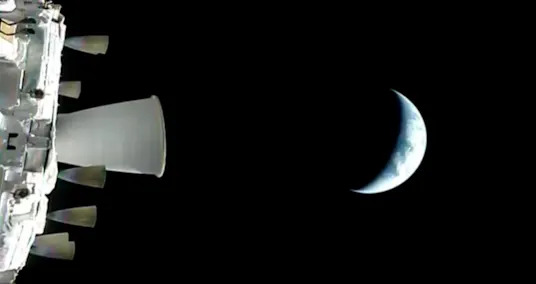
NASA’s Artemis II — the first crewed lunar mission in more than half a century — fired its main engine for nearly six minutes on Thursday, sending the four astronauts on board the Orion spacecraft out of Earth’s orbit and toward the moon for the first time since 1972. The crew is now more than halfway there, with a lunar flyby set for Monday.
The so-called translunar injection burn came on Day 2 of a 10-day journey that will take the crew around the moon and back. They launched from Kennedy Space Center in Cape Canaveral, Fla., on Wednesday.
The astronauts — NASA commander Reid Wiseman, pilot Victor Glover, mission specialist Christina Koch and Canadian space agency mission specialist Jeremy Hansen — spent their first full day in space testing the Orion capsule’s systems, using exercise equipment and taking photos documenting their historic mission.

“The crew's feeling pretty good up here," Hansen told mission control. "We just wanted to communicate to everyone around the planet who's worked to make Artemis possible that we firmly felt the power of your perseverance during every second of that burn. Humanity has once again shown what we are capable of, and it's your hopes for the future that carry us now on this journey around the moon."
Where is Artemis II now, and when will it reach the moon?
As of 12:30 p.m. ET on Saturday, the Orion was about 168,564 miles away from Earth and 111,037 miles from the moon, traveling at a speed of 2,391 mph, according to NASA’s Artemis II live mission tracker.
On Flight Day 4, the crew continued testing Orion's systems and conducting mission objectives as the spacecraft pressed deeper into cislunar space. Mission specialist Christina Koch has taken on additional duties after a toilet malfunction early in the mission required troubleshooting.
Shortly after launch, the Orion's toilet — a device NASA calls the Universal Waste Management System, which costs $23 million — triggered a warning light. The fan that controls odor and airflow had seized up, leaving the crew unable to use the urine collection system. NASA said ground teams diagnosed the problem and worked with the crew to get it back online. The issue posed no threat to the mission.
The astronauts are expected to reach the moon on Monday, April 6, at about 1 p.m. ET.
You can watch a live video feed of the mission here:
What happens when the craft reaches the moon?
During their six-hour flyby, the crew members will come as close as 4,000 miles from the lunar surface as they swing around the far side of the moon, according to NASA.
“They will devote the majority of their day to taking photos and videos of the Moon, and recording their observations as they become the first to see some parts of the Moon with their own eyes,” NASA said.
The crew will lose contact with Earth for 30 to 50 minutes as they pass behind the moon, per NASA.
And they’ll also witness a solar eclipse, giving the crew “an opportunity for them to look for flashes of light from meteoroids striking the Moon’s surface, dust lofting above the edge of the Moon, and deep space targets, including planets.”
What does the rest of the mission entail?

According to the Artemis II mission’s daily agenda, here is what’s in store on the return trip from the moon.
Day 7 (Tuesday, April 7): After exiting the “lunar sphere of influence,” the Orion engine will fire again for the first of three return trajectory correction burns that will adjust its path home. The crew members will then have the rest of the day off, “giving them a chance to rest before jumping back into their final tasks before their return to Earth.”
Day 8 (Wednesday, April 8): The four astronauts will “assess their ability to protect themselves from high radiation events like solar flares,” and also test the Orion’s manual piloting capabilities.
Day 9 (Thursday, April 9): The crew members will spend their last full day in space preparing for their return to Earth, studying procedures for reentry and splashdown, talking with the flight control team and executing another return trajectory correction burn.
When do they return to Earth?
After separating from its service module, the Orion capsule will reenter the Earth's atmosphere on Friday, April 10, deploying parachutes before splashing down in the Pacific Ocean off the coast of San Diego, where NASA and U.S. Navy personnel will be waiting to pick them up.
latest_posts
- 1
 Popular Japanese Hotel Chain Now Lets You Show Up With Just Your Passport
 - 220-year-old who threatened German train attack remanded in custody
- 3Inside Kathy Hilton’s Christmas pajama party: caviar bumps, champagne vending machines and a mansion full of Housewives
- 4Germany records first wolf bite on human since repopulation
- 5Study reveals links between global food systems, obesity, and climate change





- Seven deaths possibly linked to malfunctioning glucose monitors
- 1st-ever disease gene fix, Alzheimer's blood test: 7 medical breakthroughs in 2025
- ‘Grit’ and relentless perseverance can take a toll on brain health − particularly for people facing social stresses like racism
- U.K. blocks Kanye West from entering Britain to headline now canceled festival: What led to the ban
- EU agrees on agriculture safeguards as fronts harden in Mercosur deal
- Jupiter and the moon take a sunset stroll on March 26. Here's how to see it
- Hamas delegation meets Egypt’s spy chief amid mutual ceasefire violation claims
- Indoor Drinking Fountains: Famous Home Advancements during the Pandemic
- How did this 20-light-year-wide 'Diamond Ring' form in space? Maybe a cosmic bubble burst